Pages

Friday, March 15, 2013

That's how we roll

My gaming group has a thing for dice towers, it turns out.

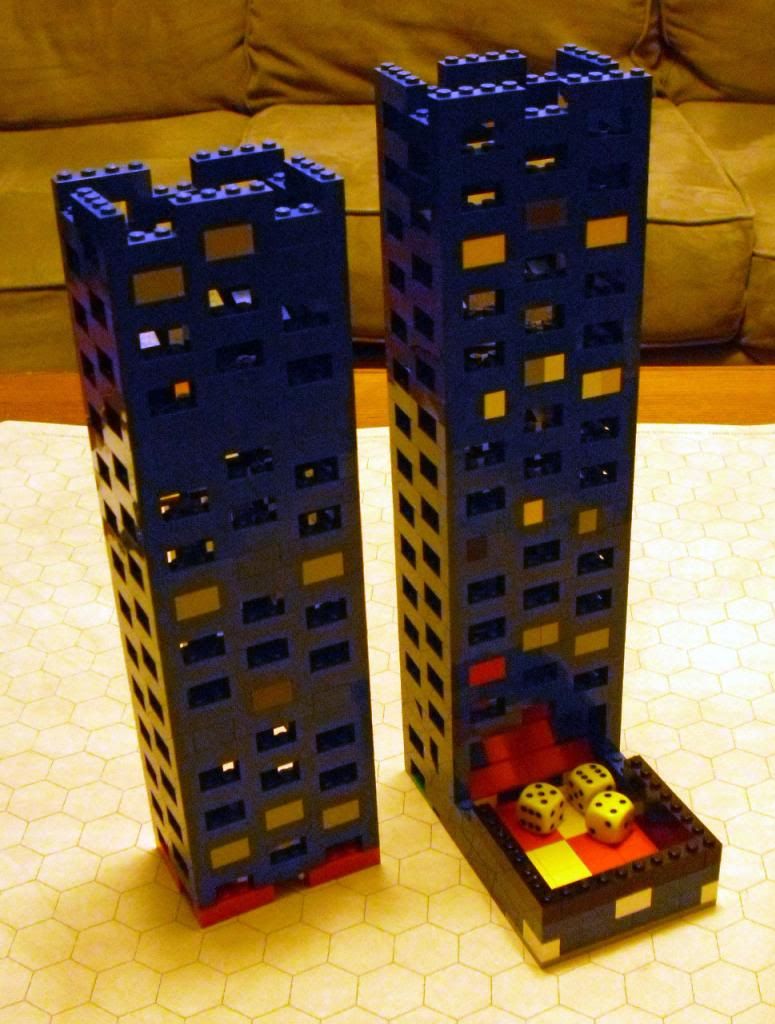
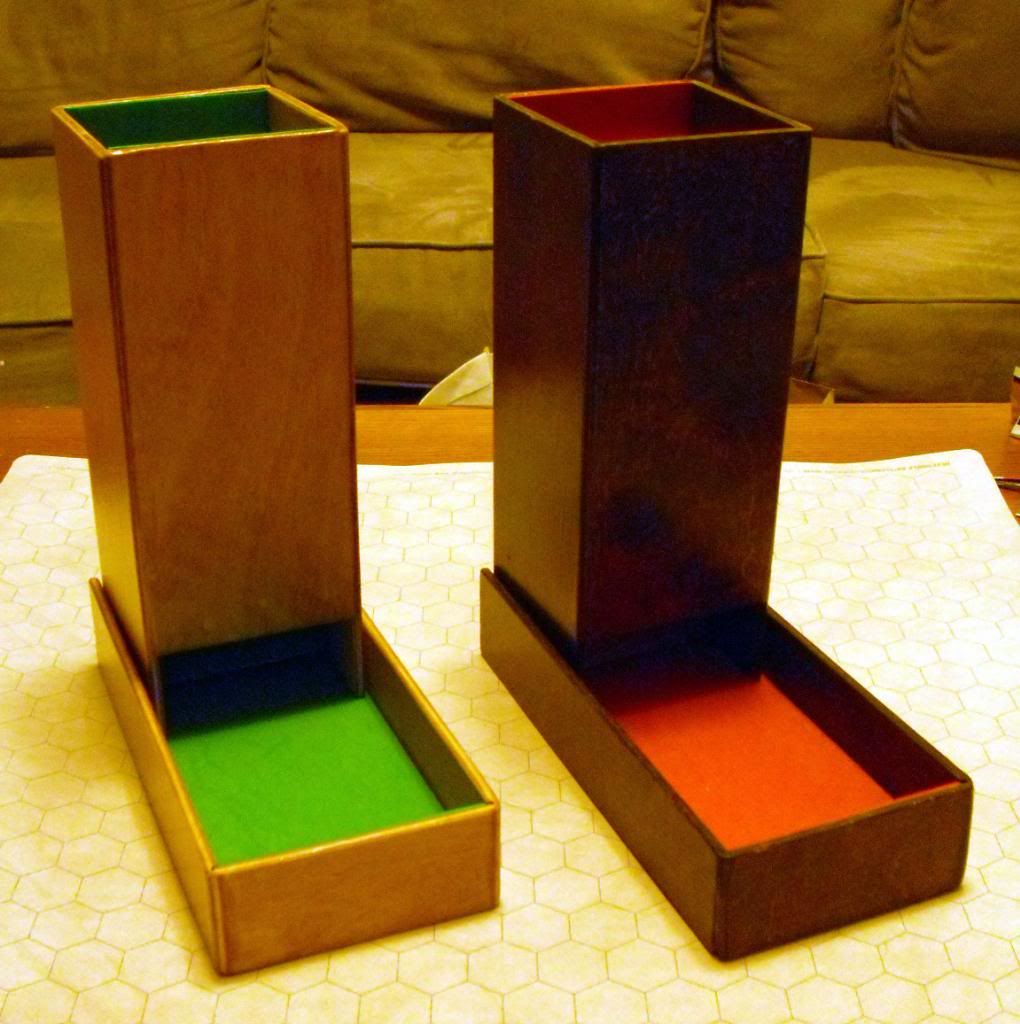
Mike started it with his dice tower, made by VixenTor.


His is the one on the right. VixenTor isn't around any more, sadly, because all of their production equipment and supplies were destroyed in a house fire.

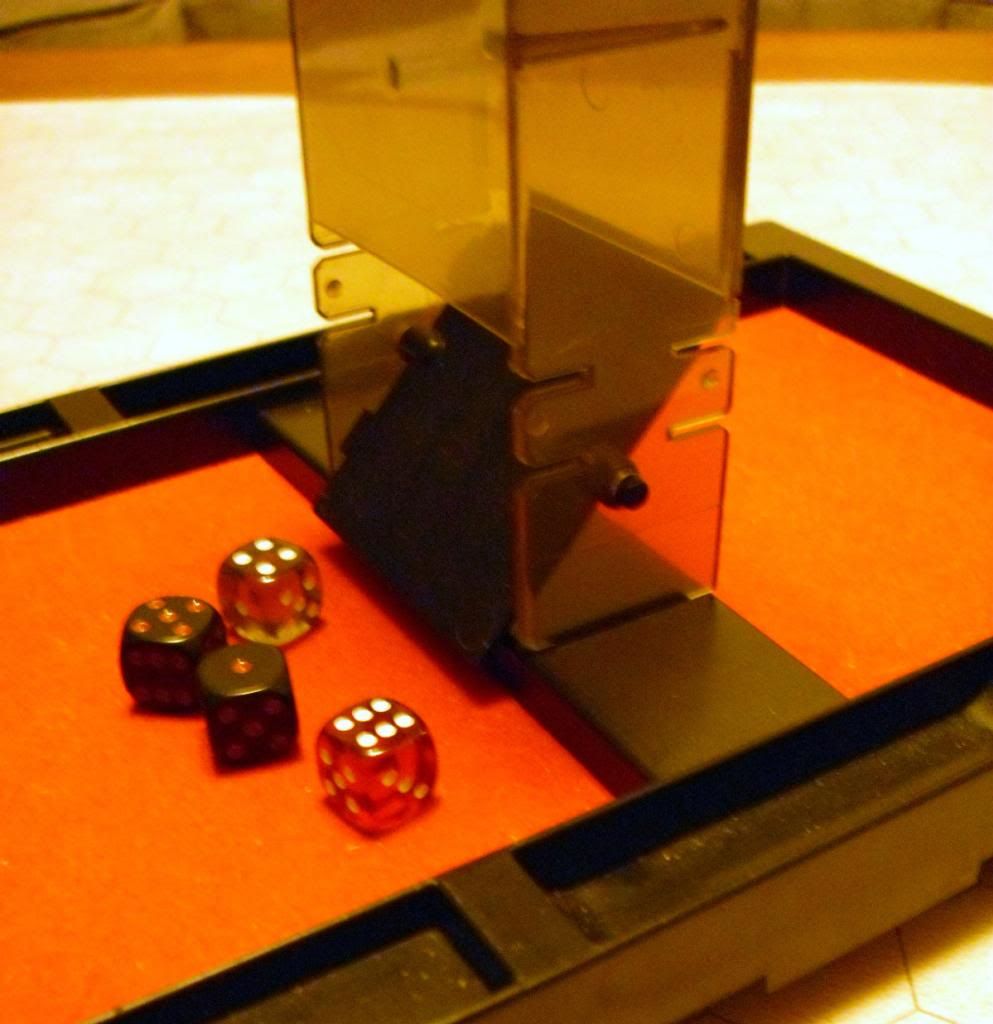
The other tower pictured above is actually Karl's, and he sometimes loans it to Echo, but he doesn't use it any more. Instead, he's got a dice tower he got form a thrift store in a copy of a board game called Chute-5.


It includes a tiltable panel at the bottom so you can make the dice fall either of the two trays, as you choose.


This seems almost useless, but I'm sure it was very important somehow to the game.

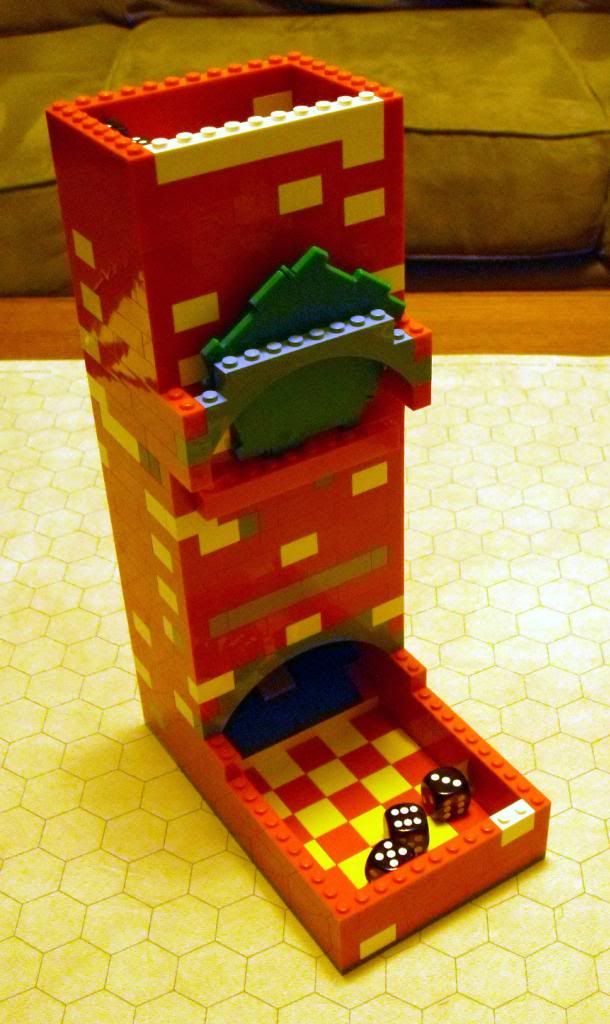
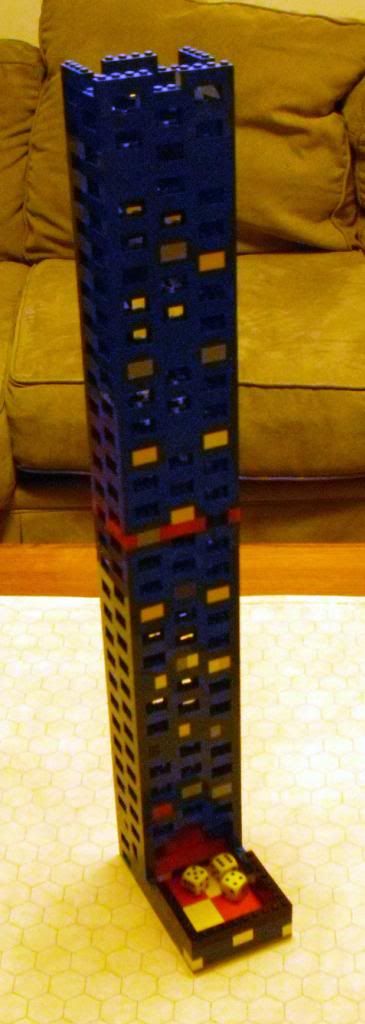
Jessica and I decided to make our own towers out of Lego. Here's hers.


She included a reroll-chit holder on the front. Because it's so annoying to lose track of your chit.

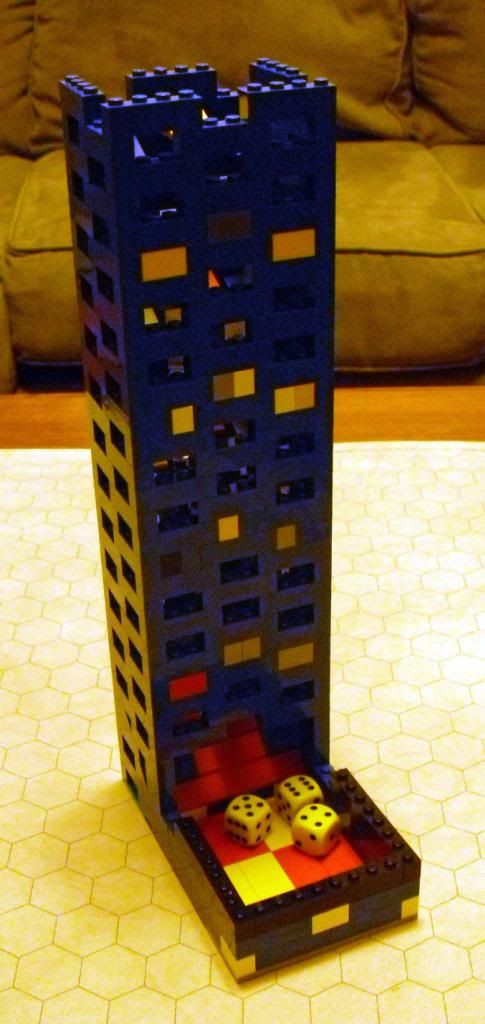
Jessica used plates to make side-to-side baffles in her tower. I opted for 2x3 low slopes to make front-to-back baffles, and a more open tower structure.


I also have an optional extension I can add on top, for when I need extra randomness.


At over 26 inches tall, it is easily the mightiest dice tower in the game.


You might think this is going a bit too far, but if you could see how random the numbers I get with this baby are, you'd have to admit it's worth it.

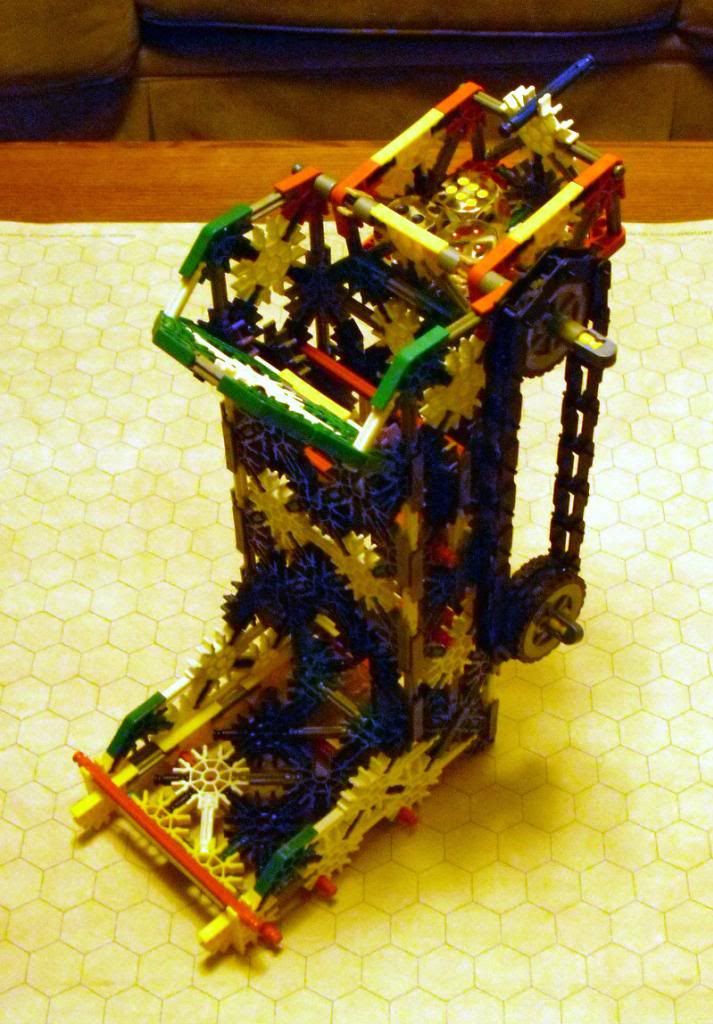
Joe, because he suffers from the delusion that K'Nex is in any way comparable to Lego, decided to make this cheap knock-off.


Yes, that's a dice basket at the top with a chain-driven axle that tilts the dice into the tower. Pathetic, isn't it? And it works about as well as you'd expect, which is to say not at all. I see this as an open admission from Joe that K'Nex are simply inferior to Lego in every respect, and this is a misguided attempt to cover that up by adding unnecessary bells and whistles to what is already a rather ugly design.

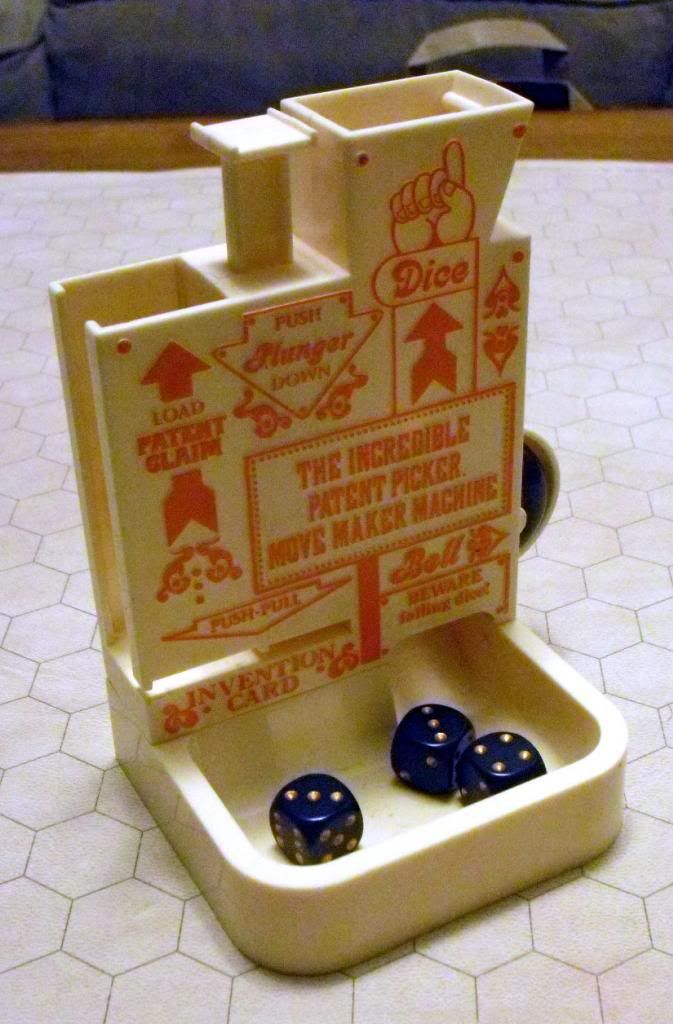
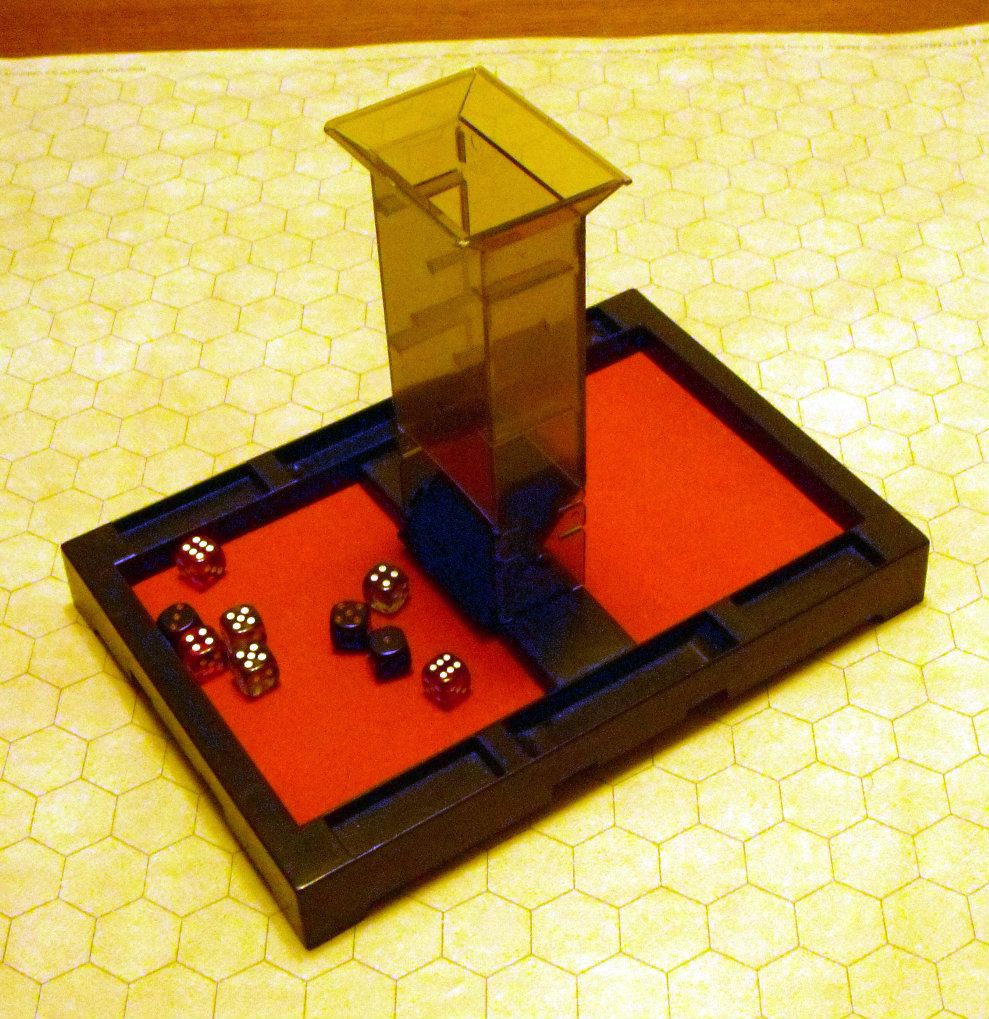
Fortunately, Joe came to his senses, and now he uses a dice tower that also comes from a thrifted board game, The Inventors.


And it actually has a bell on it. You stack the dice in the hopper on the right, push the punger next to it, and the dice ring the bell as they fall through.

And no discussion of dice towers and Lego would be complete without a tip of the hat to whoever came up with this brilliant thing here.

Edit: embedding the video failed, so I must link to it in a clumsy fashion instead. Thanks, Blogger.


Wednesday, March 13, 2013

GURPS Combat Choices: Cutting/Impaling Weapons Chart

Here's a table I've drawn up in preparation of analysis of some thrust/swing mechanics. It shows all the weapons from Basic Set, GURPS Martial Arts, and GURPS Low-Tech that have listings for both thrusting-impaling damage and swinging-cutting damage. It's mostly swords, plus some polearms and a couple of oddities.

Thrust-2 Thrust-1 Thrust Thrust+1 Thrust+2 Thrust+3
Swing-3 Small Knife, Balisong Main-Gauche Katar
Swing-2 Large Knife, Bladed Hand
Swing-1 Kukri Long Knife Saber, Light Edged Rapier, Large Katar, Shotel Large Katar (LT)
Swing Small Falchion Shortsword, Cutlass Jian, Edged Rapier, Shortsword (LT), Cutlass (LT) Pata
Swing+1 Falchion Katana 1-handed, Late Katana 1-handed, Cavalry Saber, Backsword, Qian Ku Ri Yue Dao Broadsword, Longsword 1-handed, Bastard Sword 1-handed Longsword 2-handed
Swing+2 Large Falchion Dao Katana 2-handed, Late Katana 2-handed Naginata 1-handed, Bastard Sword 2-handed, Duelling Bill, Duelling Glaive
Swing+3 Glaive, Naginata 2-handed, Greatsword, Bill
Swing+4 Duelling Halberd, Light Horsecutter
Swing+5 Halberd, Heavy Horsecutter

Note that in Low-Tech, some weapon stats changed. Shortswords, cutlasses, and large katars were bumped up one level in thrusting damage, and one-handed use of the naginata was removed.

Two trends really stand out in this table. On a diagonal axis running from upper left to lower right, weapons go from small to large. Not surprisingly, bigger weapons do more damage.

On the other diagonal, from lower left to upper right, weapons go from more choppy to more stabby. (I hope I may be excused for lapsing into technical jargon there.) On one extreme, a falchion has barely any point to it at all, and is nearly an axe. On the other extreme, the katar and the pata are about as far as you can go toward specialization in stabbing while still retaining a cutting edge. I think these two diagonal axes are more important to understanding how the weapons got their stats than the stats themselves are, and if I knew how to do it, I'd rotate this table 45 degrees and make a diamond-shaped chart with size running top to bottom, and choppy vs. stabby running left-right. Sadly, my HTML skills are not up to that.

Another thing that this chart shows is the effect of enchantment and weapon quality. Add Puissance +1 to any weapon, or make it Fine quality, and you move one space diagonally down and to the right. So a Puissance +1 jian becomes, as far as damage is concerned, a broadsword. Very Fine or Puissance +2 moves you two spaces, so a Very Fine small knife hits like a saber -- but it's rather expensive and you still can't parry with it.

In my next post on this subject, I'll crunch a great big pile of numbers and see what I have to say about swinging versus thrusting damage for these weapons.

Monday, March 11, 2013

GM Practices 2: Getting them there on time

I used to have problems getting my players to the game on time. They'd stop for snacks or something and be three, ten, fifteen minutes late. I prefer to have everyone there on time so no one is waiting on anyone else.

So to encourage punctuality, I started offering a chit good for one re-roll once during the game, usable in that session only. It's like a lesser version of luck. It's not much, but the players really enjoy it, so it gets players into seats on time.

I could just tally whether each player has used their re-roll or not during a session, but I find that giving them phyical chits helps them keep the option in mind better. For chits, I use pentagonal pieces from a Jovo construction toy set, which is a cool thing in its own way.

Sunday, March 10, 2013

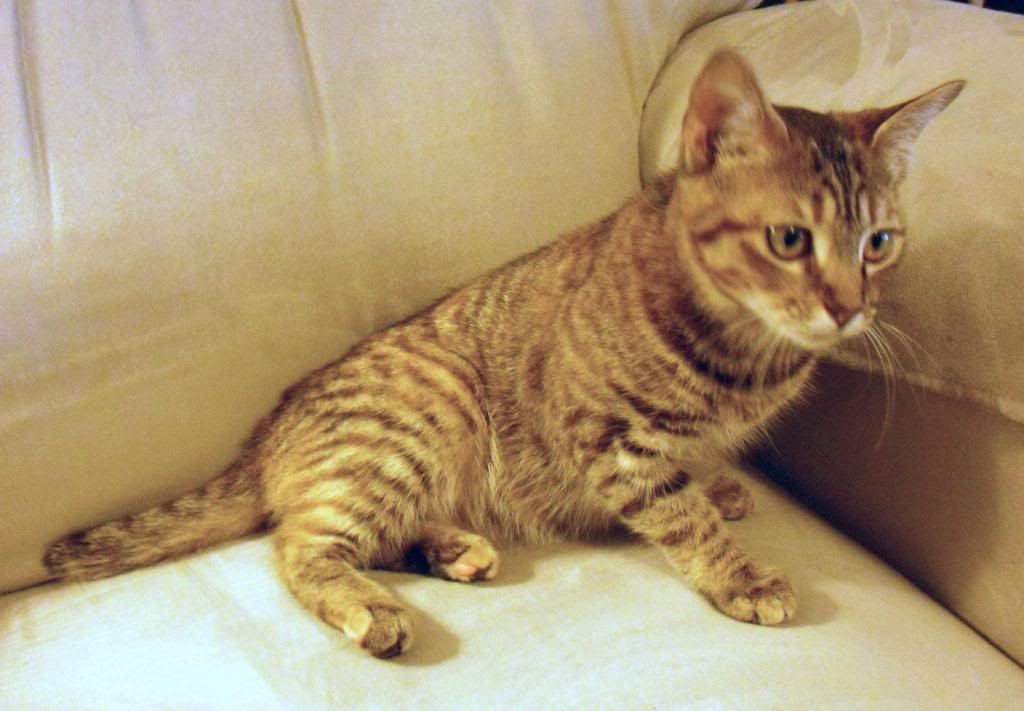
The Internet demands cat pictures

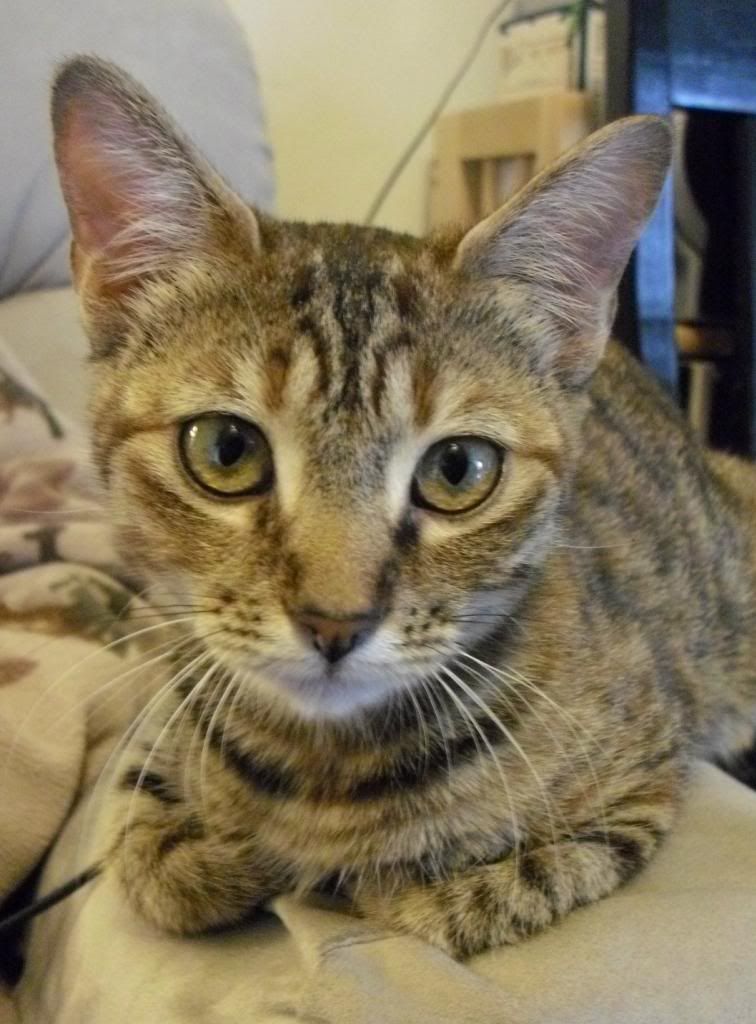
We interrupt this gaming blog to present to you these pictures of a cat.


Because we have a cat now. Her name is Chelsea and she is about 6 months old.

We now return you to our regular programming of grown men and women pretending to be elves and such.

Friday, March 8, 2013

GURPS Combat Choices: Introduction

Over at Gaming Ballistic, +Douglas Cole has been ruminating about GURPS combat, and what options become available to you as you increase in skill (see here, here, and here). His posts do a good job of helping the GURPS combatant deal with the vast array of choices available on each turn.

And they make me want to run some numerical comparisons. If you've got a choice between a Rapid Strike and a Dual-Weapon Attack, which is better? Is it worth it to try for the brain? When does Deceptive Attack improve your chances of landing a blow?

There are literally millions[1] of ways to structure an attack. In forthcoming posts, I hope to use some calculations to help clarify when one option is better than another. For the time being, this post is here to goad me into following up on the idea, and as justification to write this ridiculously long footnote.

[1] Yes, really, millions. In fairly common melee combat situations, it's easy to get that high.

Let's suppose you're squared off against another fighter at a range of one  yard, both of you equipped with thrusting broadswords, both of you standing, neither of you equipped with any armor. Only Basic Set rules apply, but none of the rules marked as optional. You have Broadsword-14 and Karate-14, and you are not incurring any other penalties for such things and darkness or bad footing. You want to make a striking attack on your opponent this turn.

Let's consider armed attacks first. To make an attack, you must decide to Thrust or to Swing, and you must pick a target. The legitimate targets depend on your Thrust/Swing choice, so let's take a look at this handy table.


Target Thrust Swing
Torso yes yes
Vitals yes no
Skull yes yes
Eye yes no
Face yes yes
Neck no benefit yes
Groin yes yes
Weapon Arm yes yes
Other Arm yes yes
Leg yes yes
Weapon Hand yes yes
Other Hand yes yes
Foot yes yes
Weapon to Disarm yes yes
Weapon to Break yes yes
Whatever target presents itself yes yes


A thrusting attack to the neck grants no benefit compared to the much easier thrust to the torso, so I do not count it as a real choice (keeping in mind for later that there may be other situations in which a thrust to the neck makes sense). Attacking the weapon hand or arm has different results compared to attacking the other hand or arm, so I consider these different targets. Contrariwise, an attack on one leg or foot or the other has the same consequences, and I don't consider those as separate targets. So that makes 15 targets for a thrust attack and 14 targets for a swing attack.

Any attack includes the option of Deceptive Attack (B370), and because a Deceptive Attack is limited to an adjusted skill of at least 10, there are three options: no DA, DA at -2, and DA at -4.

Multiplying these three options by the above number of targets gives us 3 * 15 = 45 ways to make a Thrust, and 3 * 14 = 42 ways to make a Swing. Putting these together, there are 45 + 42 = 87 ways to make a basic armed attack. I will use the letter A (for "armed") to stand for this number in counting the number of ways to use this in a maneuver.

So next you must chose a maneuver. Let's start with the Attack maneuver. You can make this a simple attack, or opt for a Rapid Strike. If you choose a simple attack, there are A different ways to do that, or if you choose a Rapid Strike, you get A choices and then A choices again.  To put it into a formula:

Options for armed Attack manuever = A + A*A
  = 87 + 7569
  = 7656.

This scenario stipulates that you are attacking this turn, and you are only one yard from your opponent, so Do Nothing, Move, Change Posture, Aim, Evaluate, Feint, Move and Attack, All-Out Defense, Concentrate, Ready, and Wait do not enter into the picture. That leaves All-Out Attack in its various forms.

For three forms of All-Out Attack, the arithmetic is the same as Attack:

Options for armed All-Out Attack (Deternined) = A + A*A = 7656.
Options for armed All-Out Attack (Strong) = A + A*A = 7656.
Options for armed All-Out Attack (Feint) = A + A*A = 7656.

For All-Out Attack (Double), either of the attacks can be at any target, and either attack (but not both) can be replaced by a Rapid Strike. That means you get either two or three picks from A attacks.

Options for armed All-Out Attack (Double) = A*A + A*A*A
  = 7569 + 658,503
  = 666,072.

Adding these all together comes to a splendidly pallindromic 696,696 possibilities for making an armed attack this turn. But what about unarmed attacks?

Sure, you're holding a sword, but it's a free action to drop it (B364), or you can hold onto it and attack with your off hand. You can then take a step into close combat and attack with fists, or stay where you are and attack with kicks, or both.

Punching is a thrust attack only and does Crushing damage. The eyes and vitals aren't legitimate hit locations for these punches, so we are left with 14 choices for hit location. As with armed attacks, you have the three options of no Deceptive Attack, DA at -2, or DA at -4. Multiplying those two together gives 3 * 14 = 42 ways to deliver a punch, which I will represent with the letter P.

With kicks, things are slightly different. Kicks are made at -2, and Deceptive Attack limits your adjusted skill to 10 or better, so you can't do a Deceptive Attack at -4, and your two choices are no DA or DA at -2. Multiplying that by the 14 legitimate targets gives 2 * 14 = 28 ways to deliver a kick, which I will represent with the letter K.

In cases where you can either punch or kick, you have to total of P + K = 42 + 28 = 70 ways to make an unarmed attack, which I will represent with the letter U. (I will need to introduce cases where you can kick but not punch later.)

The accouting here looks much the same as the accounting for an armed attack. An Attack maneuver can be either a simple attack with U choices, or a Rapid Strike with U times U choices.

Options for unarmed Attack Maneuver = U + U*U
  = 70 + 4900
  = 4970.

The arithmetic is just the same for three forms of All-Out Attack:

Options for unarmed All-Out Attack (Deternined) = U + U*U = 4970.
Options for unarmed All-Out Attack (Strong) = U + U*U = 4970.
Options for unarmed All-Out Attack (Feint) = U + U*U = 4970.

All-Out Attack (Double) is, again, where the big numbers come in.

Options for unarmed All-Out Attack (Double) = U*U + U*U*U
= 4900 + 343,000
= 347,900.

So the total number of ways to make unarmed attacks is 367,780.

We're not done yet, though. What about mixing armed and unarmed attacks in the same maneuver? For maneuvers other than All-Out Attack (Double), this is only possible with a Rapid Strike. Furthermore, the order matters. The scenario has you starting 1 yard away from your opponent. If you step into close combat to deliver a punch, you cannot then attack with your sword for a second attack. You can, however, kick at range 1 and then make an armed attack. So your options for an Attack maneuver featuring a Rapid Strike with both armed and unarmed strikes are Armed followed by Unarmed or Kick followed by Armed.


Options for mixed armed/unarmed Attack maneuver = A*U + K*A
  = 87 * 70 + 28 * 87
  = 6090 + 2436
  = 8526.


The first three All-Out Attack options are again the same.


Options for mixed armed/unarmed All-Out Attack (Deternined) = A*U + K*A = 8526.
Options for mixed armed/unarmed All-Out Attack (Strong) = A*U + K*A = 8526.
Options for mixed armed/unarmed All-Out Attack (Feint) = A*U + K*A = 8526.

An All-Out Attack (Double) without a Rapid Strike is also the same.

Options for mixed armed/unarmed All-Out Attack (Double), no Rapid Strike = A*U + K*A = 8526.


But for an All-Out Attack (Double) with a Rapid Strike, things get yet more complicated. With three strikes, which may be either armed or unarmed, there are eight possibilities:

Armed/Armed/Armed,
Armed/Armed/Unarmed,
Armed/Unarmed/Armed,
Armed/Unarmed/Unarmed,
Unarmed/Armed/Armed,
Unarmed/Armed/Unarmed,
Unarmed/Unarmed/Armed, and
Unarmed/Unarmed/Unarmed.

The first and last of these eight aren't mixed attacks, so they've already been accounted for in the purely armed or unarmed sections above. That leaves six possibilities. These are further constrained by the requirement that if an unarmed attack is followed by an armed attack, the unarmed attack has to be a kick.

So these are the rest of your choices.

Options for mixed armed/unarmed All-Out Attack (Double) with Rapid Strike
  = A*A*U + A*K*A + A*U*U + K*A*A + K*A*U + K*K*A
  = 529,830 + 211,932 + 426,300 + 211,932 + 170,520 + 68,208
  = 1,618,722.

Adding up all of these mixed armed/unarmed attacks gives us 1,661,352.

Adding that to the totals for purely armed and purely unarmed brings us to

696,696 + 367,780 + 1,661,352 = 2,725,828

total ways to make an attack.

Are we done now? Well, we could go on. I stipulated making striking attacks for this scenario, but of course you also have the option of grappling. Or you could bite instead of punching or kicking. You could also use the Pull your punches rule from B401, which would increase the number of possibilities quite a bit, depending on your Strength.

And then if you begin adding in optional rules such as Dual-Weapon Attack or Extra Effort in Combat, the possibilities increase again. And if you add in the options from GURPS Martial Arts...I think you get the idea. You've got millions of possibilities in even quite simple situation. Millions, at least.

Wednesday, March 6, 2013

Game Session 2013/03/03

Sophie O'Griffin, human, the leader and ringmaster. Played by Echo.
Esmond Gellert, human, trick-shot archer and dog trainer. Played by Mike.
Ganz, elf, stage magician and wizard. Played by Jessica.
Quexechetl, lizard man, strongman and wrestler. Played by Karl.
Talman, half-elf, acrobat. Played by Joe.
Fiorio, human, a peasant with a knack for playing to the crowd that the circus picked up along the way. Played as an NPC.

June 26, 850

When we last saw our adventurers, they had just chased an ogre into the ruined dwarven city and killed it, mainly with Esmond's bow and Talman's spear. Quexechetl had taken two good, strong blows form the ogre. He declined a healing potion, but he sat down and let Sophie bandage his wounds.

Just seconds later, some of the knights and men-at-arms from the castle caught up with the circus. Looking at the huge, bloody mess of the ogre's corpse and the mostly untouched circus performers, they clamored for an account of the fight. Sophie spoke up first, saying that the ogre was already badly wounded when they found it, no doubt from the fighting in the castle and the fall from the tower after it bashed through the wall. The others agreed, the ogre was nearly dead when they found it, and it had expired while they were trying to get their over-eager lizardman away from it.

"It kind of just fell on my spear."
Joe (Talman)

Soon after this, King Miklo himself, in the company of Count Anelmo and some of the other nobility arrived, saying they had heard that an ogre had been killed. Count Anelmo was most impressed, remarking that yesterday they didn't even know what to do with a wounded goblin, and today they had defeated an ogre. No doubt the next day, they would slay dragons.

One of the king's men, someone the performers didn't recognize, complained that the circus was acting out of place to take glory from the fighting men, but the king stifled this complaint, since he didn't like any criticism of "his circus."[1] The king and his attendants then left for the castle.

That evening, most of the army camped outside the castle, since the courtyard wasn't that large, and the Circus Sophia put on a show. Esmond didn't do very well with the dog act, but the rest of the performers did well enough, although Quexechetl was still a bit slow.

June 27, 850

Alarm! Alarm! The circus folk woke up at dawn to the news that a horde of orcs was approaching. Camp became a chaos as everyone rushed to pack up and shelter inside the ancient dwarven castle. Quexechetl and Fiorio tried to get the tent down as quickly as they could, but Quexechetl must have been suffering from the previous day's fight, because he made a mess of the job. Esmond and Sophie tried to help, but just got in the way and made matters worse. By the time they got things straightened out, they were nearly the last people to make it into the castle's very crowded courtyard, and they had to park the wagon quite close to the gatehouse, which didn't even have a gate.

Once inside, they climbed up the stairs to the top of the wall, trying to get close to the king, because Sophie was worried about an assassination attempt in the chaos of battle. From this height, they could see the entirety of the castle. It was mostly intact, but there were a few breaches in the walls. Esmond noticed that the circus wagon, along with a few others, had been overturned and used to block the gatehouse entry to the courtyard.

Soon the orcs marched into view, shouting, chanting, banging on drums, and waving weapons. They brought no siege equipment with them, not even ladders to try to scale the walls. Seeing this, most of the defenders left and went to reinforce the breaches, leaving only the archers and the king's party atop the walls. A group of mounted knights dragged the wagons out of the way and sallied out to harass the orcs.

When the orcs decided they had enough numbers, they charged and tried to overrun the breaches. Quexechetl went down to take part in the hand-to-hand fighting, while shot orc after orc with this bow. Talman and Fiorio stayed with Sophie, who kept an eye on the king. Ganz improvised an explosive fireball spell, which dispatched a knot of orcs. After that, he joined in keeping an eye on the king. He noticed Archmagus Tor of the Lodean court casting protective spells on King Miklo, while Count Anelmo commanded the battle. Lord Fels led his men in hand-to-hand fighting in the courtyard.

The first wave of orcs failed in their attack, there was a lull, and then another wave charged. This pattern continued for most of the day, and the defenders were never in serious danger. In the mid-afternoon, the remaining orcs retreated to the north, leaving a couple thousand dead behind them.

Casualties among the king's army were much lighter. After the fighting, Sophie tended to the wounded as best she could, and tried to get a sense of the army's opinion of the orcs' attack. Everyone agreed that it wasn't typical of orcs to attack a well-defended position like that. The majority opinion was that orcs are just stupid, and there's no explaining what they do. But some of the wiser and more experienced among the army supposed that maybe the castle was important to the orcs' prestige, or that the attack was a result of political competition among the orcish tribe, or that the orcs were simply overpopulated that year. In the end, no one had a good explanation for what seemed like a suicidal attack.

The performers did their best to gather their belongings, which had been spilled out of the wagon and mostly left in a pile, and bedded down for the night.

June 28, 850

After sleeping in their armor and keeping an alert watch, the next morning, the army broke camp and marched north, pursing the orcs. Around noon, they came to a convergence of three valleys and faced the choice of a path to the northeast or one to the west-northwest. As the members of the circus were wondering which way they would go, a hush fell over the army. Everyone's attention was drawn to the west, where the faraway but distinct silhouette of a dragon could be seen lazily circling in the air. It lingered in view for no more than half a minute, and when it passed behind a mountain, everyone remembered to breathe again.

The Circus Sophia was too far from the front of the army to tell who made the decision about which way to go, or what motivated them, but soon the army began marching again, and not in the direction of the dragon.

June 29, 850

The next day's travel brought the army to a narrow but steep ravine. On the far side, after a few hundred yards of grass and scrub, the trees came together into a proper forest. The king's engineers prepared to lay a bridge over the ravine so the wagons could cross, and a vanguard of knights rode forward to guard the opposite side.

When the vanguard came within arrow's flight of the trees, hundreds of orcs emerged from the cover and shot at them. Not knowing how many more were concealed in the forest, the knights withdrew back to the ravine. The engineers, worried about the security of the bridgehead, settled in for a long argument about how best to handle the task of getting the army to the other side.

In the afternoon, after most people had decided to begin setting up camp, a servant approached Ganz, and relayed a request for his presence by his grace the Archmagus Tor [2]. Ganz, of course, said he would be happy to oblige the Archmage, and followed the servant to a large and finely decorated tent.

Inside the Archmage welcomed his colleage, as he called Ganz, and pointed out a certain ruined tower on a ridge a couple miles away, on the near side of the ravine. The Archmage explained that this was an ancient wizard's tower, and he had heard from veterans of previous campaigns against the orcs that there were magical glyphs engraved in the stones there. The Archmage had wanted to investigate this for himself, but since the orcs might attack at any moment, he was required to stay and protect the king. Would Ganz be willing, with his circus friends as protection, to to climb up to the tower and make a sketch of the glyphs? It would be a long climb and there wouldn't be much light left when he got there, but an overnight stay should be safe, since the orcs were very superstitious about magic and avoided the tower.

Ganz said he would be happy to. He took his leave of the Archmage and returned to the circus wagon. Everyone wanted to go, but Sophie thought Fiorio should stay with the wagon and mind their belongings. The performers packed for an overnight stay and set out.

The climb was steep, and the sun was much lower in the sky when they neared the tower. In its ruined state, it was little more than a low circular wall with a pile of rubble surrounding it. Esmond kept a sharp eye out for trouble, and Ganz cast a Sense Foes spell, but no one saw any signs of danger.

There was, indeed, a belt of glyphs carved into the stone in a belt around the outside of the tower, a little above waist height. There were a few gaps where stones had fallen away, but it was mostly intact. Ganz set about copying them down on paper, while the others looked around for fallen stones with glyphs on them. Esmond discovered a stairway leading downward just inside the ruined walls, blocked by rubble. They decided to leave it unexcavated for now.

Ganz finished his transcription a little before sundown, and though he wasn't very familiar with dwarven schools of magic, he came to the conclusion that they were some sort of protection signs. He finished off by casting an illusion of the scene of the whole ruin, with all the glyphs in place, in order to fix it in his memory.

The circus then settled down for the night, with Sophie assigned the first watch, Esmond the second, and Talman the third. Quexechetl was already asleep. Esmond passed the magical pendant he usually wears to Sophie, to let her see in the dark.

Toward the end of Sophie's watch, after the moon had set, she saw, down in the valley, another army of orcs marching toward the camp! They marched silently and slowly, with none of the drumming and chanting that usually announced their presence. She woke up the others, and though they couldn't see, she explained that the orcs had doubled back behind the king's army, and were making a nighttime attack on their rear!

With the camp a couple hours away by foot and all the orcs about, Ganz felt that only way to warn the army was with magic. He considered teleporting Sophie back, but decided that was too risky. Better would be if he flew there himself. He cast a spell, transformed himself into a foxhawk [3], and took off.

Almost immediately, he saw that a group of orcs had departed from the main horde and were climbing the ridge toward the tower. There were a couple dozen, at least. He circled back to the tower, landed, and yipping and pointing with a paw, got Sophie to take another look down the slope. This time, she saw the orcs that were climbing toward them, and warned the others to prepare to defend the tower.

Ganz took off again and flew to the army's camp. He landed just outside the lines, then dismissed his spell and returned to the form of an elf. He found a sentry and warned him about the approaching orcs, then ran off to the Archmage's tent and repeated his warning. The message delivered, he snuck out into the darkness at the edge of camp, cast his transformation spell once more, and flew back to the tower.

As he approached, he saw that he had undercounted the orcs. There must have been at least sixty of them, and though their climb was slow, they would reach the tower before long. He landed, transformed back into an elf, and updated the others on the enemy numbers.

Talman thought they might do best to flee, since the orcs probably didn't even know they were there, weren't coming for a fight, and wouldn't miss them if they left. The others thought it would be too dangerous to leave a defensible position with that many orcs roaming around. They decided to stay, and thought this might be a good time to clear away the rubble and see where those stairs led.

While Quexechetl stood guard, Esmond and Talman started clearing. It was tough going, and they hadn't made much progress when the orcs came within arrow range. The climbed slowly, looking tired. Quexechetl and Esmond traded places, and Esmond took the amulet of night seeing back from Sophie. He drew his bow and carefully watched the orcs. Ganz cast a Light spell, and began concentrating to send it down the slope to light up the orcs.

When they got to withing fifty yards, Esmond shot. His arrow thudded home into the chest of one of the advancing orcs. The orcs kept coming, silently. Esmond drew again, aimed, and loosed another arrow. He hit the same orc again. The orc didn't so much as cry out, and kept coming.

Esmond drew another arrow, and this time as he aimed, he saw that the orc he had just shot twice wasn't the only one with arrows in him. As they got nearer, he could see, plain as day in the darkenss by the virtue of his magical amulet, that the orcs were all dead. And yet still they marched forward.

Me: Yes, it turns out that they are zombie orcs. Or, "zorcs," if you will....
Karl: I will not.

He shot a third arrow, trying to hit the orc squarely in the forehead, but his shot missed. He dropped the bow, drew out his shortsword and buckler, and prepared to hold the gap in the wall that faced the orcs. Talman backed him up with his spear. Sophie said a quick prayer to Wen, god of the underworld, climbed up on the wall, and readied her bow. Ganz did his best to help Quexechetl with the digging.

The first of the dead orcs reached the tower. Esmond stood at the gap in the wall. Two of them closed with him and attacked with axes. One missed, and he deflected the other with his buckler.

Esmond struck back, slashing the orc across the throat with his sword. Behind him, Talman stabbed with his spear, but failed to connect. More dead orcs stumbled toward Sophie, where she perched atop the wall, and the two that faced Esmond attacked again. One of them connected, severely wounding him and nearly knocking him down.

"This would be a good time to find out that this is all a nightmare."
Mike (Esmond)

Quexechetl dug frantically at the rubble blocking the stairs, and cleared barely enough room to let an elf  squirm through, but not enough for himself. It seemed unlikely they would clear enough to get everyone underground before the orcs overwhelmed them. Ganz decided to take a long shot, and concentrated on the magical glyphs that he had studied so carefully, hoping to somehow activate them.

Sophie shot an arrow at one of the dead orcs, hitting it but not slowing it down. It stabbed twice at her with a spear, missing both times. Esmond, struggling to remain conscious, slashed again with his sword, then stepped back from the wall. Talman attacked with his spear again and missed.

Ganz, concentrating on the glyphs, thought that he had somehow connected with them. Sophie felt that her prayer had been answered, and hopped down from the wall. The dead orcs stumbled around outside, but made no attempt to enter through the gap in the wall. The circus performers were safe, but for how long?

Esmond quickly gulped a healing potion, while Quexechetl finished clearing the rubble from the stairs. As soon as there was enough room to crawl through, everyone hurried downstairs. They examined the small, round, vaulted room by the light of Sophie's lantern. There was a summoning circle of some sort on the floor, a table and chair against one wall, and a cabinet against another.

So, how did that go?

Things moved along more slowly that I would have liked. Everyone's attention kept wandering, including mine. It had been more than a month since our last game, because of one thing an another, and I think that may have been a part of the reason.

And, of course, things did not go as I had expected. When do they ever? I didn't expect JC to have Ganz fly off by himself to warn the army about the approaching orcs, but that was fine. I thought the group made a mistake by not clearing the stairs and investigating under the tower when they first got there. On the other hand, JC caught me totally off guard by having Ganz attempt to activate the glyphs. I just threw in "they're protection wards" off the cuff.

Ganz has a Thaumatology of 14, so I added up some penalties and bonuses in my head and came up with 7 for him to activate the glyphs. Then I remembered Sophie's brief prayer to Wen, so I bumped it up to 8. JC used Luck to make three rolls, and the third and best was an 8. So they were just barely saved, by virtue of that prayer. I think the current situation made for a very good stopping point.

One thing I think I need to manage better is my way of describing what's going on in the world. In order to make it seem like this story unfolds in a real place, I try to describe what's going on all around the party -- what the army is doing, how the orcs act, what a dragon flying in the distance looks like, and so on. But while I'm doing that, I'm not asking the players what their characters are doing. In the current situation, where they're following an army and have to go where it goes, it feels like I'm spending too much time on things they have no control over. I need to work on compressing that description and getting on the good parts where they get to decide to do something.

[1] The Circus Sophia performed at the king's coronation feast, along with various other entertainers. In a strange mixup, a second circus, also named the Circus Sophia, was likewise scheduled to perform. The assembled nobles thought this was improper, and formed the general opinion that the two circuses should compete for the right to use the name. Our heros won, narrowly but convincingly, and afterward the court awarded the Circus Sophia a royal charter entitling them to call themselves "Entertainers to HIs Majesty King Miklo." Queen Luccola even gave them a banner embroidered with this slogan.

[2] The circus has met the Archmage once before, in the aftermath of the strange plot by an alchemist to  kidnap the king's cousins and use them in a ritual to do...something. The Archmage led the investigation to find out who else was involved, and eventually the Dean of the Royal College of Alchemists was arrested. The Archmage is also a member of the Lodean regency council, along with four other people. I'm not sure any of the players remembers this.

[3] A foxhawk is just what it sound like --  a hybrid with the body of a fox, but with a hawk's wings and forefeet. They have normal coloration for a red fox, but with a line of feathers along the spine and banded coloration on the belly, white and red or red-brown. The circus encountered these creatures when they met the reclusive alchemist Fiuzo Panzal. He had made several, and they had escaped from their pens. After the circus recaptured them for him, Ganz decided he liked them enough to want to be one, at least temporarily, and improvised a transformation spell.
Monday, March 4, 2013

GM Practices I: Question of the (Every Other) Week

Here's a simple thing that I do that other GMs might find useful in their own games.

I run a GURPS fantasy game every other Sunday, with occasional interruptions. In order to make sure my players know that yes, this is the week we're gaming, I send out a reminder email on Fridays before a game.

And that works, but only up to a point. People have a habit of glancing at routine email and then immediately forgetting about it. So I started including a question about the game with each email. I ask the players to think about it, and then each game we take a few minutes to talk about the subject.

I find that this helps people to remember that they got the reminder email, and also it gives me some idea of how the players are enjoying the game and what I could do to improve it. Here are some of the questions I've asked over the course of the campaign:
  • What do you think is the most important thing you found out last game?
  • What do you think is the best possible outcome for the circus in the current situation? What's the minimum that you would consider a win? What would you consider a loss?
  • (About a caper they had decided to pull just as the last game ended.) For this jailbreak, what do you think your tactical advantages over the Gondans are? What are your disadvantages?
  • Is there anything about the rules we play with that particularly bugs you? If so, do you have a suggestion for how we could change it?
  • How would you feel about adding another player to the group? If I was looking for someone, would you have someone in mind? How would you feel about it if it were a complete stranger?
  • Is there any aspect of the gameworld you would like to see fleshed out more? Geography? History? Religion? Technology? Folk songs? Cuisine? Card games?
  • Which NPCs would you like to meet again? Which ones would you rather never meet again?
  • If your character were to get the chance to have some formal training in something, what would you like it to be?
  • What has been your favorite part of the campaign so far? What has been your least favorite part?
  • What in-game circumstances, positive or negative, would make you want to retire your character? What would make you say, "Okay, this person's story is over. Time for someone new"? If there are any positive outcomes that would make you want to do that, is there one your is character actively working toward that as a goal?
  • Suppose I were to run a short alternate game as a break from the Circus Sophia campaign. What sort of game would you be interested in? Pulp adventure? Buck Rogers-style science fiction? Modern shoot-em-up? Fantasy, but of a different sort? Would you be interested in taking a turn as GM for yourself?
  • The GM says to you, "Okay, I'm going to advance the timeline. X days/months/years pass, and we pick up the story then..." How do you feel about the GM doing this? What amount of time, if any, makes this a fun-killing move by the GM?
 Sometimes I drop in a little bit of background information about a new city the PCs have just traveled to, or a new group that they've encountered. And sometime I can't think of anything and I don't ask a question at all. But I manage to think of something for most of our gaming sessions, and I think it helps to keep me actively thinking about how the game is going.